Bob Hope’s Wartime Correspondence – It all began for Bob Hope in a low-key manner back in the spring of 1941. Hope, who got his start in show business through vaudeville and Broadway, was on his way to becoming one of the most popular comedians of all time. At the time, he was starring in motion pictures for three years, with upcoming releases such as “Caught in the Draft” and “The Road to Zanzibar” ready to conquer the box office. Also, his highly rated Pepsodent Show on NBC Radio made him a familiar voice with millions of American listeners every week.

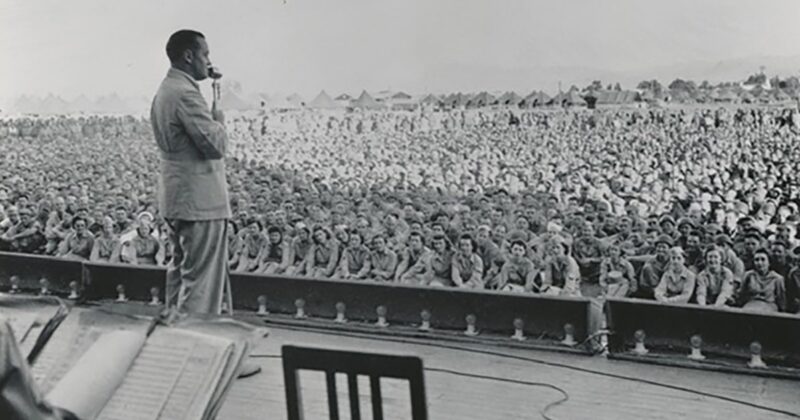
So thanks to his radio show producer Al Capstaff, Hope got a request to do a future Pepsodent Show broadcast live on location from March Field, a U.S. army base in Riverside, California. Hope agreed, and on May 6, 1941, he did his first show in front of an audience made up of chiefly servicemen who packed the base’s gymnasium during a hot 94 degree day to be entertained in person from the entertainer who was heard in their families’ homes every week on radio.
What could have been a one-shot deal in the spring of 1941 snowballed into something magnificent for the men and women who served in every branch of the U.S. Armed Forces after the U.S. entered into the fighting of the conflict that was World War II, following the attack on Pearl Harbor.

For the next four years, between regularly-scheduled movie and radio commitments, Hope and his small troupe of entertainers that included singer Frances Langford, comedian Jerry Colonna, writer Barney Dean, tap dancer Patti Thomas and guitarist/one-man band man Tony Romano, packed up their old kit bags and travelled a total of 30,000 miles in practically every corner of the globe to perform in 150 live shows that took place in army bases, airfields and makeshift theatres in remote locations, for the sole purpose of providing entertainment, morale boosting and a kind of therapeutic healing “for the boys (and girls)” who bravely served their country in their quest to defeat Nazi Germany and the imperial Japanese empire. And on top of that, Hope and his crew visited the wounded in every field hospital that was located in every base where they performed, giving the wounded troops a much needed boost, which always began with his enthusiastic customary greeting of “Don’t get up, fellas!”.

And the main way for these servicemen and servicewomen to express their gratitude to Bob Hope for making the arduous journey to their respective bases in the European and Pacific theatres of the war was through the mail. These thank you letters were filled with immense gratitude, funny anecdotes and how much Hope’s live shows were a much needed slice of home and meant so much as they were fighting a deadly conflict. In fact, by 1944, Hope was receiving an average of 38,000 letters from soldiers every week!
It’s been exactly 80 years since that first show at March Field that turned Bob Hope into the “G.I.’s best friend” and led to a commitment that saw him tirelessly entertain troops in Korea, Vietnam, the Persian Gulf and even during the height of the Cold War. And those hundreds of thousands of G.I. thank you letters he received between 1941 and 1945 form the basis of a terrific tribute to service in book form called Dear Bob…

This book was put together by two women who have a close connection to Bob Hope: Linda Hope, his daughter and Martha Bolton, who worked as his staff writer for 15 years. They had the enormous task of sifting through the extensive collection of those letters (which are now kept in the Library of Congress) to see which ones would be included in the book. Their hard work has paid off, as the selected letters represent the many issues and concerns that these soldiers opened up to Hope, such as the sometimes primitive conditions of bases in the South Pacific, the food offered at the mess hall, missing the family every Christmas, missing mom on Mother’s Day, surviving harrowing battles, recuperating from all kinds of wounds and requests for certain entertainers and starlets in future shows.
This book reads like a scrapbook, and is generously sprinkled with letters (and replies from Hope), rare onstage and backstage photos from many of the USO shows, artifacts, one-liners uttered in Hope’s trademark self-deprecating style, and excerpts from speeches from show closings, newspaper articles, two of the best selling books Hope wrote during the war, and many of the Allied military and government figures whose decisions contributed to their victory in 1945.
But when you read these letters of gratitude from the soldiers, they give a sense of poignancy and pride of the risks they took fighting for their country, and how major an impact seeing a Bob Hope live show had towards their morale on the front lines, or towards their personal healing lying in a field hospital bed. One glaring example of the latter was a letter dated February 1945 by army Private O.M. Teate, who was temporarily blinded from a grenade explosion and was recovering in a military hospital in Louisiana. When one Tuesday night at 9 p.m., he heard the theme song to Hope’s show on the radio in his hospital ward, it gave him the boost that he needed towards his healing as a result from the multitude of laughter he got during that 30-minute broadcast.
“I only hope that you can understand my appreciation for making me feeling like smiling and helping me to realize that there is still some joy in life, no matter what the circumstances maybe,” writes Private Teate near the end of his letter.
Dear Bob … is a wonderful, moving testimony to selfless service to one’s country at its very best, especially in a time of crisis. Bob Hope and company may have provided a lot of laughs and good times when he travelled wherever the soldiers were, no matter how dangerous it was, but he knew it was for a gallant purpose. That sense of purpose was well explained during one closing tribute that Hope delivered at the conclusion of one of his broadcasts:
“We know them as the finest fighting machine and the finest audience in the world. So on this closing show (of the season), we’d just like to wave a temporary goodbye and mumble a few words to the effect that if a few fellows, who’ll soon be closing an even bigger show in Berlin and Tokyo, have gotten a few laughs out of these Tuesday nights, we’re completely and utterly grateful. And what’s more, we’ll keep on dishing it out as long as they can take it.”
Thanks for the memories indeed, Mr. Hope.

Other articles from mtltimes.ca – totimes.ca – otttimes.ca

Montrealers protest against COVID-19 lockdown

Latest Canadian UFO sighting