
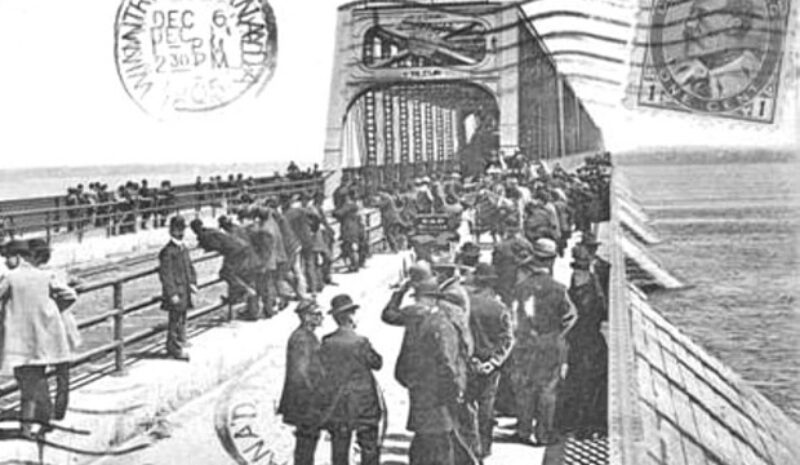
Hailed at the time as the 8th wonder of the world, the Great Victoria Bridge was the first bridge over the St. Lawrence in Montreal erected between 1854 and 1859. It was officially rededicated as the Victoria Jubilee Bridge following renovations in 1897 and returned to the name Victoria Bridge in 1978.

The first freight train passed over the bridge on December 12, 1859 and the first passenger train crossed the bridge five days later on December 17.
Queen Victoria had been invited to attend the opening of the bridge, however, she declined and instead sent her eldest son, Albert Edward, the Prince of Wales, who officially inaugurated the bridge on August 25, 1860.
Before the bridge was built, the city’s economic activity slowed during winter months when the river was frozen. The bridge allowed trains to carry goods to Portland, Maine, an ice-free harbour from which they could be shipped to Europe. It was a colossal project involving over 3,000 workers in 1858. The British company responsible for building the bridge brought over skilled workers from Great Britain. Brute labour was provided by Irish from Griffintown and the Point, and Mohawk workers from Kahnawake. When completed, it was the longest bridge in the world (approx. 3 km (1.9 mi) long, with 24 ice-breaking piers) erected at a cost of $6,600,000.
The chief engineer was James Hodges. The original deck was a long structural metal tube made of prefabricated sections made in England. The contractors were the English partnership of Peto, Brassey and Betts. In 1897 the metal tube from 1860 was replaced by metal trusses, common at the time. The stone piers from 1860, slightly altered in 1897, still testify to the excellent original engineering. The St. Lambert Diversion around the St. Lambert Locks was added in 1958 as part of the St. Lawrence Seaway project. This secondary bridge over the canal, south of the main bridge, also carries both road and rail, and is used when a ship is passing under the original alignment.
When the bridge was being built, workmen discovered the human remains of Irish immigrants to Canada, who had fled the famine in Ireland, only to die during the typhus epidemic of 1847 in fever sheds at nearby Windmill Point. At the bridge approach, a large rock was erected, officially called the Irish Commemorative Stone but locally known as The Black Rock.
It was lifted out of the river in 1859 by workers building the Victoria Bridge, who decided to make it into a memorial.
Its inscription reads: ”To preserve from desecration the remains of 6000 immigrants who died of ship fever A.D.1847-8 this stone is erected by the workmen of Messrs. Peto, Brassey and Betts employed in the construction of the Victoria Bridge A.D.1859”.
The bridge remains in use to this day, carrying both road and rail traffic. rails in the middle and roadways on both sides. It is actively used by the Canadian National Railway on its Halifax to Montreal main line. It is a major contributor to Montreal’s role as a continental hub in the North American rail system.
by Dick Nieuwendyk – info@mtltimes.ca
Other articles from mtltimes.ca – totimes.ca – otttimes.ca

Mtl Duct Cleaning and dryer vent cleaning answering all your questions