DMARC, AI threats, compliance mandates, and the path to full email resilience
The Email Security Crisis: A Threat Landscape in Overdrive
Over one million phishing attacks were recorded in Q1 2025 alone, and 1 in 4 emails reaching corporate inboxes is now classified as malicious or unwanted. According to Barracuda Networks’ 2025 Email Threats Report, 90% of cyberattacks still begin with a phishing email, and 74% of all data breaches involve human error.
The average cost of a phishing-related data breach reached $4.88 million in 2025, a 10% year-over-year increase. For U.S. organizations, the average climbs to $10.22 million. Business Email Compromise (BEC) alone was responsible for $2.77 billion in reported losses in 2024.
In this environment, email authentication and protection are no longer optional – they are fundamental business requirements.
Email Authentication 101: SPF, DKIM, and DMARC
SPF (Sender Policy Framework)
SPF is a DNS-based protocol that specifies which mail servers are authorized to send email on behalf of your domain.
DKIM (DomainKeys Identified Mail)
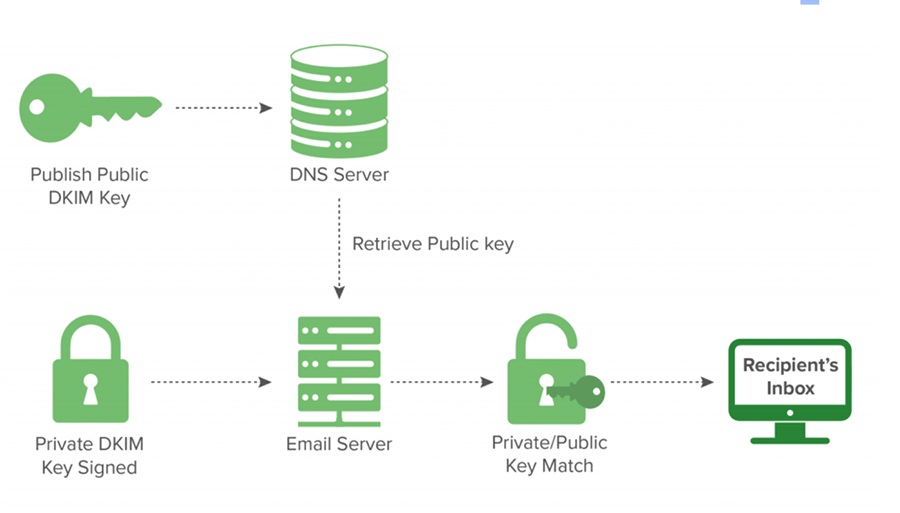
DKIM adds a cryptographic signature to outgoing emails, allowing the receiving server to verify that the message has not been tampered with in transit.
DMARC (Domain-based Message Authentication, Reporting, and Conformance)
DMARC ties SPF and DKIM together with a policy that tells receiving servers what to do with messages that fail authentication.
| Protocol | What It Does | Where It Lives | Protects Against |
|---|---|---|---|
| SPF | Verifies sending server is authorized | DNS TXT record | Spoofed sender IPs |
| DKIM | Verifies message integrity with crypto signature | DNS TXT record + email header | Message tampering, spoofing |
| DMARC | Sets policy for failed authentication + reporting | DNS TXT record | Domain impersonation |
The DMARC Maturity Journey: From Visibility to Resilience
DMARC adoption among top domains surged 75% between 2023 and 2025, climbing from 27.2% to 47.7%. However, only 10.7% of domains have reached full protection with a “reject” policy. The DMARC maturity journey follows six progressive steps.
The Limits of DMARC Alone
While DMARC at enforcement is a critical first step, it only protects against exact-domain spoofing. It does not protect against lookalike domains, dangling DNS records, or subdomain takeover attacks. A comprehensive email security posture requires three layers:
| Layer | Product | What It Protects Against |
|---|---|---|
| 1. Policy Enforcement | Red Sift OnDMARC | Exact-domain spoofing, unauthorized senders |
| 2. DNS Protection | Red Sift DNS Guardian | Subdomain takeovers, dangling DNS, misconfigurations |
| 3. Lookalike Defense | Red Sift BrandTrust | Lookalike domains, brand impersonation, phishing kits |
Vircom’s email security services deliver all three layers through their partnership with Red Sift, helping organizations achieve full enforcement in 6–8 weeks.
Why 2026 Is the Year of Mandatory Email Authentication
Google, Yahoo, and Microsoft Sender Requirements
As of 2026, all three major mailbox providers now redirect unauthenticated emails to spam or reject them outright. For bulk senders (5,000+ emails daily), requirements include SPF, DKIM, and DMARC with domain alignment, valid reverse DNS, TLS encryption, and one-click unsubscribe for marketing messages.
PCI DSS v4.0 Requirements
PCI DSS v4.0, fully effective since March 2025, mandates “automated mechanisms” to protect against phishing for all organizations handling credit card data. Industry best practices define this as implementing SPF, DKIM, and DMARC at enforcement level.
Canadian Federal Government Requirements
Canadian federal organizations are required to implement SPF, DKIM, and DMARC under Email Management Services configuration rules.
The AI-Powered Phishing Tsunami
56% of phishing emails analyzed in late 2025 showed indicators of AI generation. AI-crafted phishing messages achieve 60% higher click rates than human-written ones. AI allows attackers to generate grammatically perfect, contextually relevant phishing emails at scale – eliminating the spelling mistakes and awkward phrasing that once served as red flags.
| AI Phishing Metric | Value | Source |
|---|---|---|
| Phishing emails with AI indicators | 56% (late 2025) | Hoxhunt |
| AI phishing click rate improvement | 60% higher than human-crafted | Barracuda |
| End-of-year AI phishing surge | 14x increase | Hoxhunt |
| Small business employees targeted | 350% more than enterprise | KnowBe4 |
| BEC losses (US, 2024) | $2.77 billion | FBI IC3 |
DNS Guardian: Closing the Subdomain Gap
SubdoMailing – the exploitation of abandoned or misconfigured subdomains to send authenticated phishing emails – emerged as a major attack vector. DNS Guardian continuously monitors your entire DNS configuration to detect and prevent these attacks. As of today, it is the only product offering this specific protection.
Brand Trust: Stopping Lookalike Domain Attacks
Brand Trust uses AI-powered monitoring to detect newly registered lookalike domains, assess their threat level, and initiate takedown procedures. The platform continuously scans certificate transparency logs, domain registrations, and web content to identify impersonation attempts in real time.
Choosing the Right Email Security Partner
Managed vs. Self-Service
Many organizations lack the internal expertise to manage DMARC enforcement, DNS monitoring, and brand protection. A managed service provider handles the technical complexity.
Speed to Enforcement
The goal is to reach DMARC enforcement (reject policy) as quickly as possible without disrupting legitimate email flows. The best email security solutions achieve this in 6–8 weeks through Vircom’s guided or managed OnDMARC service.
BIMI and Brand Visibility
BIMI (Brand Indicators for Message Identification) allows organizations that have achieved DMARC enforcement to display their verified logo next to emails. Studies show BIMI improves open rates by 39% and brand recall by 44%.
Take Action Before You Become a Statistic
Email security in 2026 demands a multi-layered defense: DMARC enforcement, DNS protection, and monitoring for lookalike domains. Contact a specialist in email security and DMARC compliance for a complimentary assessment covering the full Red Sift suite – OnDMARC, DNS Guardian, and Brand Trust.
Other articles from totimes.ca – otttimes.ca – mtltimes.ca