Three Days at the Brink – For over 85 years, political observers and pundits have measured a newly-elected U.S. President’s early progress of their new administration by seeing what they have done, accomplished or failed during their first 100 days in office.
Fox News host Brett Baier measures an American President’s historical legacy by only three significant consecutive days, which usually happen towards the end of their presidencies. And he transcended this approach to two New York Times best-selling books: one dealing with Dwight Eisenhower (Three Days in January) and the other with Ronald Reagan (Three Days in Moscow).
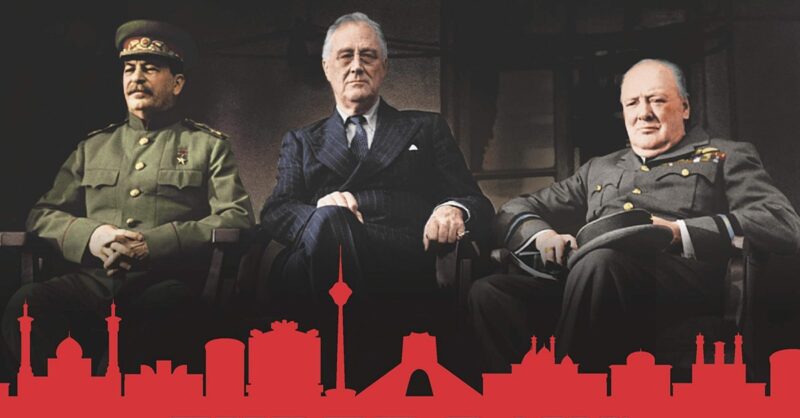
And now, for the third book in this Three Days trilogy, he focusses on Franklin D. Roosevelt and the three days he spent in 1943 conferring with Winston Churchill and Joseph Stalin in Tehran on what action to take to precipitate the beginning of the end of World War II; the end result is Three Days at the Brink.

The common thread with these three books is how these three Presidents dealt with the beginning, middle and end of the Cold War during three significant events in modern history. With Three Days at the Brink, it focuses on the first time Roosevelt, Churchill and Stalin met together in person to discuss a common strategy to defeat Nazi Germany and Japan (in particular, getting Stalin to agree on Britain and the U.S. to carry out Operation Overlord, the invasion of Normandy, in 1944 to break the Nazis’ grip on most of Western Europe). As well, Roosevelt wanted to make Stalin feel welcome as part of the Allied Big Three, as well as to find out what were his growing ambitions for Eastern Europe once the Nazis were defeated, which would later lead to the Iron Curtain descending upon that region.
And how did Roosevelt carry out this bit of conciliation and deference to Uncle Joe Stalin? He did it by agreeing to almost everything Stalin suggested during the Tehran Conference, and openly criticizing and somewhat invalidating any opinion or theory that was expressed by Churchill (although he realized its was a ploy by Roosevelt to curry favour with Stalin, he still felt slighted by this 180-degree turn that was done by his friend and ally). Somehow it worked out at the Tehran Conference, but by the time the Allied leaders met again at Yalta and Potsdam in 1945, this air of cordiality between the U.S., Britain and the Soviet Union fell apart with Stalin’s aggressive territorial demands for Eastern Europe.
In the 430+ pages that make up this book, Baier has done quite an admirable job of proving how three days in Tehran in 1943 set the stage for an Allied victory in World War II, as well as the shape of international relations for the next 45 years. And I commend how he has effectively managed to tell the story of Franklin Roosevelt, the man and the politician, and the events of his life and career (such as his marriage to Eleanor, his years as Undersecretary of the Navy, his bout with polio, his unprecedented four successful presidential election campaigns and the legislation he enacted that helped to end the Great Depression in America … the things that would normally take up large, multi-volume biographies in their own right) in a fraction of the space (in this case it’s in the first half of the book). However, thanks to Baier’s diligent research, we find out some interesting factual tidbits regarding the meetings, back and forth negotiations, conversations and state visits (secret and public) that helped to bring about the vital gathering of the three leaders in Tehran that made the difference to turn the tide of the war in the Allies’ favour. My favorite tidbit dealt with Soviet Foreign Minister Vyacheslav Molotov, who made his first visit to Washington in May of 1942, and stayed in the White House under the pseudonym of Mr. Brown; when a valet unpacked his suitcases, it was discovered that it also contained a sausage, a loaf of black bread and a loaded pistol, which caused the First Lady to quip: Mr. Molotov evidently thought he might have to defend himself and also he might be hungry.
Three Days at the Brinkis a fascinating look at diplomacy at its most urgent and its most unusual at a time when the fate of the free world was at stake. It shows how a man of peace did what it took to confront a man of steel … two men of different backgrounds and temperaments but shared a common bond: that of obtaining long-lasting peace from the ashes of a deadly conflict that enveloped the world and its people.

Other book reviews: