
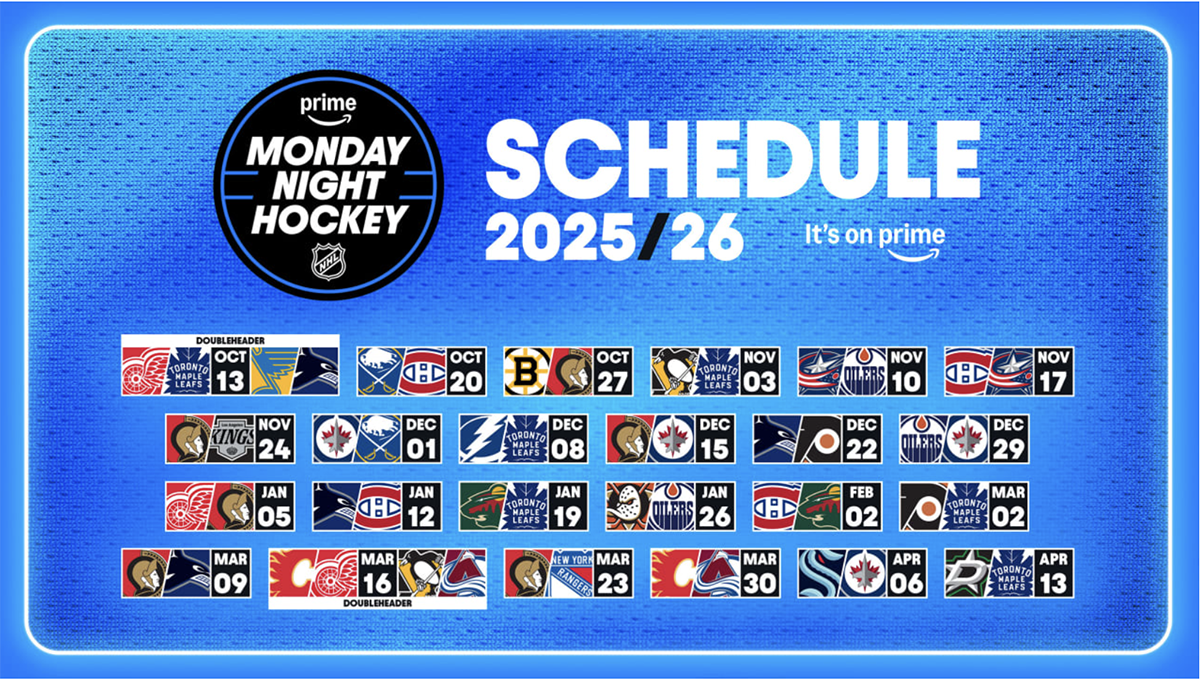
Prime Monday Night Hockey has carved out a distinct place in Canada’s NHL viewing habits. What started as a modern streaming initiative is now a weekly national broadcast that places select games under heightened scrutiny. These Monday nights are not defined by spectacle alone. They are moments where teams are evaluated on discipline, execution, and composure in front of a country-wide audience.
For the Montréal Canadiens, the 2025–26 season includes four appearances in this national broadcast window. Each game represents a checkpoint rather than a headline event. These matchups do not determine a season on their own, but they influence how progress is measured, how trends are identified, and how the Canadiens are discussed beyond the local market. Over time, these four games form a useful framework for understanding Montréal’s season.
A National Broadcast That Carries Different Weight in Montréal
Prime Monday Night Hockey differs from regional coverage in one important way: it creates a shared national conversation. Fans across Canada watch the same shifts, the same mistakes, and the same responses. For teams featured in this window, performances are absorbed immediately into broader league narratives.

For Montréal, this visibility carries added significance. The Canadiens are not evaluated solely as a developing team, but as a franchise deeply tied to Canadian hockey identity. National audiences tend to focus on effort, structure, and accountability when watching Montréal. Prime’s broadcast format does not magnify hype; it magnifies habits. How the Canadiens manage these games reflects the maturity of the roster and the clarity of the organization’s direction.
Early Season: Establishing Standards Rather Than Results
Montréal’s first Prime Monday Night Hockey appearance arrives early in the season, a period when teams are still defining how they want to play. Early national games often influence perception because they offer one of the first extended looks at how offseason development has translated onto the ice.
For the Canadiens, this moment is less about outcome and more about standard. Pace, positioning, and decision-making tend to stand out more than scoring totals. Canadian audiences often look for signs of cohesion: how the team moves together through the neutral zone, how it manages defensive coverage, and how it responds when the game tightens.
This first appearance provides an opportunity to demonstrate clarity. Playing with purpose and structure under national attention sets a reference point that shapes how later performances are evaluated.
Midseason: Discipline Under Routine Pressure
As the season moves into its middle months, conversation around the league shifts. Depth, durability, and consistency become central themes. Montréal’s second Prime Monday Night Hockey appearance comes at a time when the schedule begins to wear on teams and small issues become harder to hide.
Midseason national broadcasts often expose tendencies. Penalty discipline, line changes, and puck management are more noticeable when fatigue enters the equation. Canadian fans tend to value teams that stay organized during these stretches, especially when momentum swings threaten to disrupt structure.
For the Canadiens, this game functions as a test of restraint. It shows whether the team can remain committed to its systems when circumstances are less forgiving. A controlled performance at this stage suggests progress that goes beyond individual flashes.
Midwinter: Playing Under Expectation at Home
A Prime Monday Night Hockey game in Montréal places the Canadiens in a familiar but demanding position. Home games come with energy, but they also come with expectation. National broadcasts amplify that dynamic, turning routine shifts into moments of evaluation.
In these settings, attention often shifts to composure. How does the team respond to early pressure? How does it manage emotion after momentum changes? Canadian viewers tend to notice whether structure holds when the pace increases and the atmosphere intensifies.
This appearance offers Montréal a chance to show balance, confidence without overextension, urgency without disorder. These traits matter less in isolation than they do as indicators of long-term growth.
Late Season: Meaningful Games Without Margin
By March, the NHL calendar leaves little room for error. Games take on added weight, and execution becomes more important than experimentation. Montréal’s final Prime Monday Night Hockey appearance falls within this phase, where every decision carries consequence.
Late-season games between Canadian teams are often defined by familiarity and restraint. Puck management, defensive detail, and situational awareness become priorities. These games resemble playoff environments in tone, if not in stakes.
For the Canadiens, this matchup offers a snapshot of readiness. Not readiness in terms of results, but in terms of approach. Staying composed, limiting mistakes, and managing pressure provide insight into how the team handles demanding hockey.
Why Prime Monday Night Hockey Matters in the Bigger Picture
Prime Monday Night Hockey does not define a season on its own, but it shapes perception. These broadcasts create moments where progress is visible, habits are highlighted, and patterns are discussed nationally.
For Montréal, four appearances across different phases of the season allow for comparison: early structure versus late execution, midseason discipline versus late-season urgency. These contrasts offer a clearer picture of development than any single stretch of games.
At the same time, Prime Monday Night Hockey reflects a broader shift in how Canadians experience the sport. As viewing platforms evolve, shared national broadcasts continue to matter. Montréal’s presence in this space reinforces its ongoing role in Canada’s hockey conversation, even as the league and its audiences change.
Final Thoughts: Four Windows, One Season Narrative
The Montréal Canadiens’ four Prime Monday Night Hockey appearances during the 2025–26 season serve as reference points rather than turning points. Each game offers a different context and a different test, from early-season identity to late-season execution.
Together, they provide a useful lens through which to view the season as a whole, not by isolating wins or losses, but by observing how the team responds to pressure, manages expectation, and maintains structure when the country is watching.
In a league where perception is shaped in real time, these four nationally shared moments help tell the story of Montréal’s season, quietly, consistently, and under a spotlight that reveals more than it hides.
Disclaimer: This article may contain affiliate links, and we may earn a commission if you make a purchase through these links.
Other articles from totimes.ca – otttimes.ca – mtltimes.ca