MONTREAL, October 29, 2026 — Picture it: 9:30 on a Friday morning in April 1967. An atomic clock counts down to zero, the gates swing open, and somewhere in a crowd of more than 300,000 people, a 41-year-old jazz drummer from Chicago named Al Carter becomes the very first visitor to the biggest party Montreal has ever thrown. (They gave him a gold watch for it. Punctuality pays.)
Expo 67 — officially the 1967 International and Universal Exposition — ran from April 28 to October 29, 1967. Sixty-two nations took part, more than 50 million visits were logged, and to this day it’s remembered as one of the most successful world’s fairs of the 20th century. And you know what the wild part is? It almost happened somewhere else entirely, and for a while nobody was sure it could happen at all.
The fair that was supposed to be in Moscow
The 1967 World’s Fair was originally slated for Moscow, where the Soviet Union planned to mark the 50th anniversary of the Russian Revolution. The Soviets eventually pulled out, and Montreal mayor Jean Drapeau pressed Ottawa to make another bid. On November 13, 1962, the Bureau International des Expositions (BIE) handed the fair to Canada — perfect timing for the country’s centennial year.
Not everyone was thrilled. Support across Canada was lukewarm at first, and Drapeau’s site choice raised eyebrows: rather than build on existing land, he wanted to enlarge Île Sainte-Hélène in the St. Lawrence and create a brand-new island beside it. The plan beat back opposition from neighbouring municipalities and kept land speculators out of the picture, and the site was officially announced on March 29, 1963.
Then things got bumpy. In 1963, many of the organizing committee’s top officials resigned. The island scheme was one reason; another was that a computer analysis predicting the fair simply couldn’t be built in time. Politics likely played the biggest part: on April 22, 1963, Lester B. Pearson’s Liberals took power, and board members appointed by John Diefenbaker’s Progressive Conservatives were effectively shown the door.
A new management team took over, and — spoiler — they ignored the computer.
Building islands out of the river
Construction kicked off on August 13, 1963, with a suitably theatrical ceremony on barges anchored in the St. Lawrence. Prime Minister Pearson pulled a lever that signalled a front-end loader to dump the first load of fill, and Quebec premier Jean Lesage climbed onto a bulldozer to spread it.
The islands needed some 25 million tons of fill. About 10 to 12 per cent came from tunnels being dug for the new Montreal Metro; the rest came from quarries on the island and the South Shore. Even that wasn’t enough, so the designers carved lakes and canals into the islands to reduce how much earth they needed. The work enlarged Île Sainte-Hélène, created the entirely artificial Île Notre-Dame, and stretched the Mackay Pier into what became the Cité du Havre.
The finished land wasn’t handed over to the Expo corporation until June 20, 1964. That left Colonel Edward Churchill, the man in charge of construction, exactly 1,042 days to get everything built. His secret weapon was a then-new planning technique called the critical path method. On opening day, everything was ready — except Habitat 67, which was proudly shown off as a work in progress.
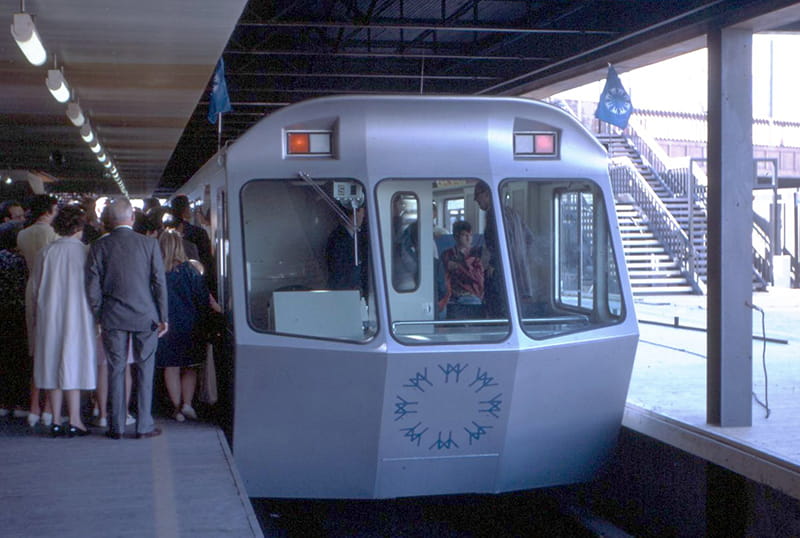
It wasn’t cheap. Building the islands, the new Concorde Bridge, the Expo Express transit line and a boat pier cost more than the St. Lawrence Seaway, which had opened just a few years earlier — and that was before a single pavillion went up. Expo general manager Andrew Kniewasser presented a preliminary construction budget of $167 million in the fall of 1963; it passed Pearson’s cabinet by a single vote and was formally submitted on December 23, 1963. By 1967, it had ballooned to more than $430 million.
“Man and His World”
In May 1963, a remarkable brain-trust gathered for three days at the Seigneury Club in Montebello, Quebec: National Gallery director Alan Jarvis, novelists Hugh MacLennan and Gabrielle Roy, geophysicist J. Tuzo Wilson and town planner Claude Robillard, among others. They came away with the fair’s theme, “Man and His World,” borrowed from Antoine de Saint-Exupéry’s 1939 book Terre des Hommes (published in English as Wind, Sand and Stars).
The theme spun off a series of exhibits — Man the Explorer, Man the Creator, Man the Producer, Man the Provider, Man in the Community and Man and His Health — plus showpieces like the Labyrinth, Habitat 67 and the 372-seat Du Pont Auditorium of Canada.

The logo, designed by Montreal artist Julien Hébert, took an ancient pictogram for “man,” paired two of them to suggest friendship, then repeated the pair in a circle: friendship around the world. It was set in lowercase Optima type. Not every politician was charmed. Some MPs actually tried to kill it with a motion in the House of Commons.
The fair even had its own soundtrack. The official theme, Stéphane Venne’s “Hey Friend, Say Friend / Un jour, un jour,” won an international contest that drew more than 2,200 entries from 35 countries. But the song most Canadians link with Expo is Bobby Gimby’s “Ca-na-da,” technically the official Centennial anthem rather than the fair’s, though in the summer of ’67 the two were practically inseparable. The Canadian pavillion used “Something to Sing About,” written for a 1963 TV special, and Ontario’s pavillion gave the world “A Place to Stand, A Place to Grow,” still the province’s unofficial iconic anthem.
Opening day
The official opening on Thursday, April 27, 1967, was an invitation-only affair at Place des Nations. Pearson lit the Expo flame and Governor General Roland Michener declared the fair open before more than 7,000 guests, including 53 heads of state. Over 1,000 reporters covered it, and the ceremony went out live by satellite, in colour, to an audience of more than 700 million.
The public got in the next morning. Organizers expected around 200,000 people; somewhere between 310,000 and 335,000 showed up. Two days later, on April 30, Expo set a single-day world’s fair record of 569,500 visitors.
The talk of opening day? The hostesses at the U.K. pavilion, dressed in the brand-new miniskirts Mary Quant had made famous. Canada Post (then the Post Office Department) marked the occasion with a 5¢ commemorative stamp designed by Harvey Thomas Prosser.
Stars, royals and a puppet festival
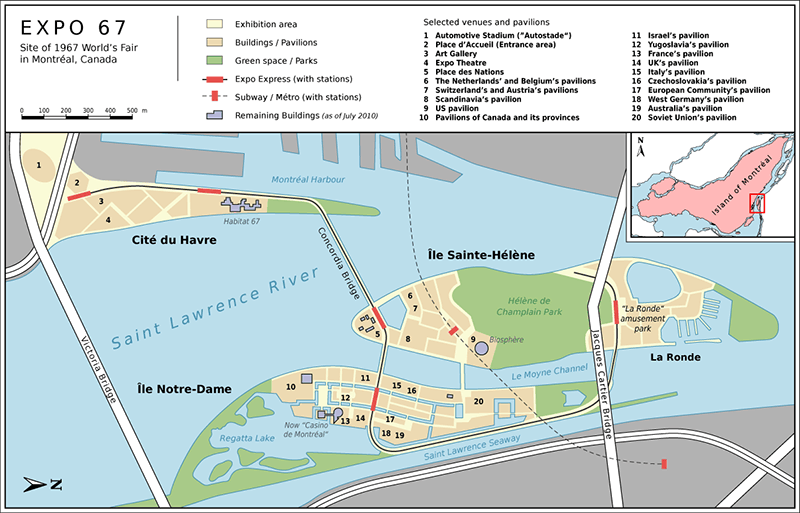
Expo’s World Festival of Art and Entertainment brought opera, ballet, theatre, orchestras, jazz and Canadian pop to venues including Place des Arts, the Expo Theatre, Place des Nations, La Ronde and the Automotive Stadium. Many pavillions had their own free stages, and puppeteer Micheline Legendre organized Canada’s first puppetry festival. When the fairgrounds closed around 10 p.m., night owls could keep going at La Ronde — the amusement park built to outlast the fair, and which still does.
The Ed Sullivan Show broadcast live from Expo on May 7 and May 21, with the Supremes, Petula Clark, the Seekers, and conductor Wilfrid Pelletier leading the Montreal Symphony Orchestra with soprano Birgit Nilsson and pianist Ronald Turini.
The guest list reads like a 1967 who’s who: Queen Elizabeth II (who rode the minirail with Pearson on July 3), Lyndon B. Johnson, Princess Grace of Monaco, Jacqueline Kennedy, Robert F. Kennedy, Emperor Haile Selassie of Ethiopia, Charles de Gaulle, Bing Crosby, Harry Belafonte, Maurice Chevalier, Maharishi Mahesh Yogi and Marlene Dietrich. The Grateful Dead, Jefferson Airplane and Tiny Tim all played for the crowds.
Not everything went to plan
By the end of July, forecasters were predicting more than 60 million visits. Then came September and a 30-day transit strike that took a big bite out of attendance and revenue just as the fair headed for the finish line.
Accommodation was another headache. A service called Logexpo steered visitors to places to stay — often the spare rooms of Montrealers who opened their homes to strangers. Some guests, though, were sent to less-than-respectable establishments run by operators cashing in on the tourist rush. Logexpo was run by a Quebec provincial authority, not Expo, but Expo took most of the blame. Even so, a trip to the fair was widely seen as a bargain.
The last day
Expo was supposed to close on Friday, October 27, but the BIE granted a two-day extension so it could run through the weekend. On Sunday, October 29, another 221,554 people came through the gates, bringing the final attendance count to an impressive 54,991,806 — in a country of only about 20 million people. That per-capita attendance record still stands.
At 2 p.m., Commissioner General Pierre Dupuy handed out gold and silver medals to participating nations and organizations, and the flags came down in the reverse of the order they’d gone up: Canada’s first, Nigeria’s last. Pearson put out the Expo flame, and Governor General Michener closed the fair with a sad, unscripted farewell: “It is with great regret that I declare that the Universal and International Exhibition of 1967 has come to an official end.” The rides stopped at 3:50 p.m., the grounds closed at 4, the last Expo Express pulled out, and an hour of fireworks lit up the river.
And the bill? Expo was always expected to run a deficit, shared by Ottawa, Quebec and the city. Thanks to bigger-than-expected crowds, it came in well under forecasts: about $221.2 million in revenue against $431.9 million in costs, for a deficit of $210.7 million (in 1967 dollars).
Ninety pavillions and a whole lot of film
Expo featured 90 pavillions representing themes, nations, corporations and industries — and almost all of them used film somehow. One commentator summed it up neatly: “Expo was a fair of film.”
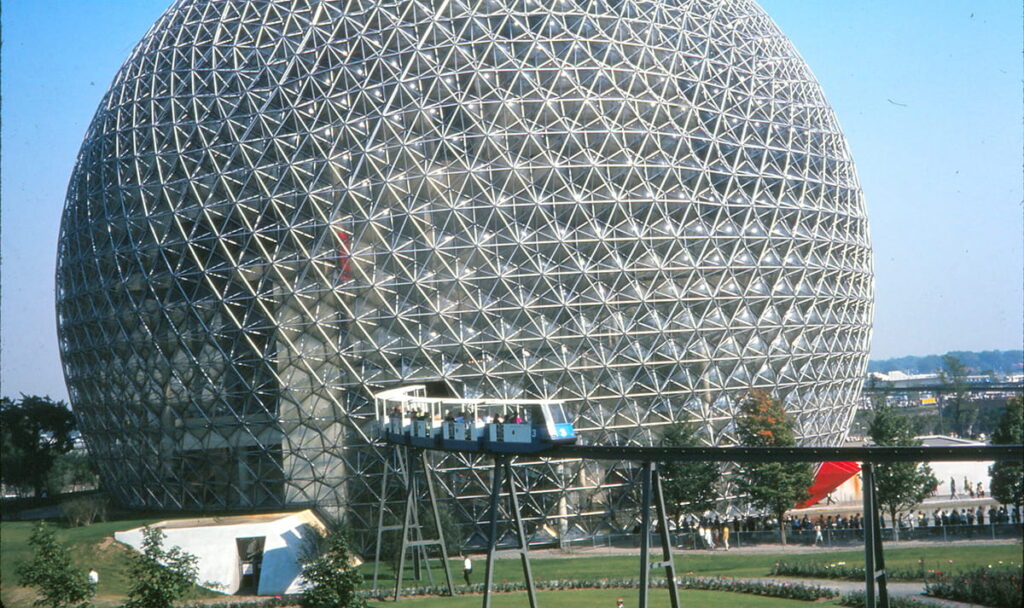
The Soviet Union’s pavillion was the biggest draw, with about 13 million visitors; afterwards it was taken apart and shipped to Moscow. Next came Canada (11 million), the United States (9 million) — housed in Buckminster Fuller’s famous geodesic dome — France (8.5 million) and Czechoslovakia (8 million).
Iran’s pavilion, designed by Abdol-Aziz Mirza Farmanfarmaian, stood out among the concrete and steel with its blue Isfahan tile exterior. Inside were Persian tilework, mirror work, woodcraft, historical artifacts and displays on the country’s oil industry, all set to traditional tar music. At its heart sat a “Pool of Wishes,” where visitors tossed coins and wished for a trip to Iran. Iranian magazine Zan-e Rooz reported that about 40 people staffed the pavilion, including 11 women, most of them National Iranian Oil Company employees working as guides.
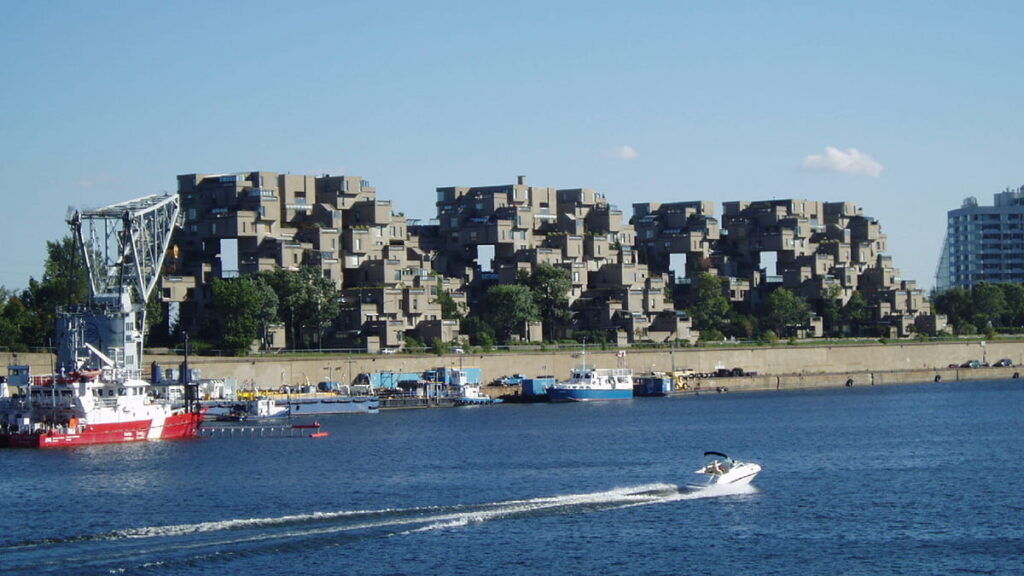
And then there’s Habitat 67, Moshe Safdie’s stack of modular concrete homes. Unlike most of the fair, it’s still standing — and people still live there.
What’s left
After the gates closed, the site carried on as a summer exhibition called Man and His World from 1968 to 1984. But most of the buildings had never been designed to last, and as they deteriorated, they came down. Today the islands are mostly parkland, known since 1999 as Parc Jean-Drapeau in honour of the mayor who willed the whole thing into being, with only a handful of Expo structures left as clues to what happened there.
The fair left other marks, too. When Major League Baseball awarded Montreal a team in 1969, it was named the Expos in the fair’s honour. (They’re now the Washington Nationals.) Expo 67 was the best-attended world’s fair up to that time; only Osaka 1970 and Shanghai 2010 have drawn bigger crowds since.
Historian Pierre Berton credited the fair’s success to a partnership between French and English Canada, though he cautioned that the tidy stereotypes behind that idea were oversimplified. Still, for one summer at least, Expo arguably bridged the “Two Solitudes.”
Yves Jasmin, who spent 45 months on the Expo team, later wrote a French-language book about the experience, La petite histoire d’Expo 67, and founded the Expo 67 Foundation to keep the memory alive for future generations. Next fall marks 60 years since the gates closed. Something tells us Montreal won’t let it pass quietly.
lead photo by Gail Goldstein