Meta has rebuilt the system that decides which ads people see. The winners will be the brands with the most varied creative, not the most complex campaigns.
If you advertise on Facebook or Instagram, the rules just changed again. On October 28, 2026, Meta’s engineering team published details on the new generation of Andromeda, the system that picks which ads can be shown to each person. Marketers quickly nicknamed it “Andromeda 2.0”.
Behind the technical language, the message for Montreal businesses is simple: Meta can now look at every one of your ads, and it rewards variety.
How Meta picks an ad
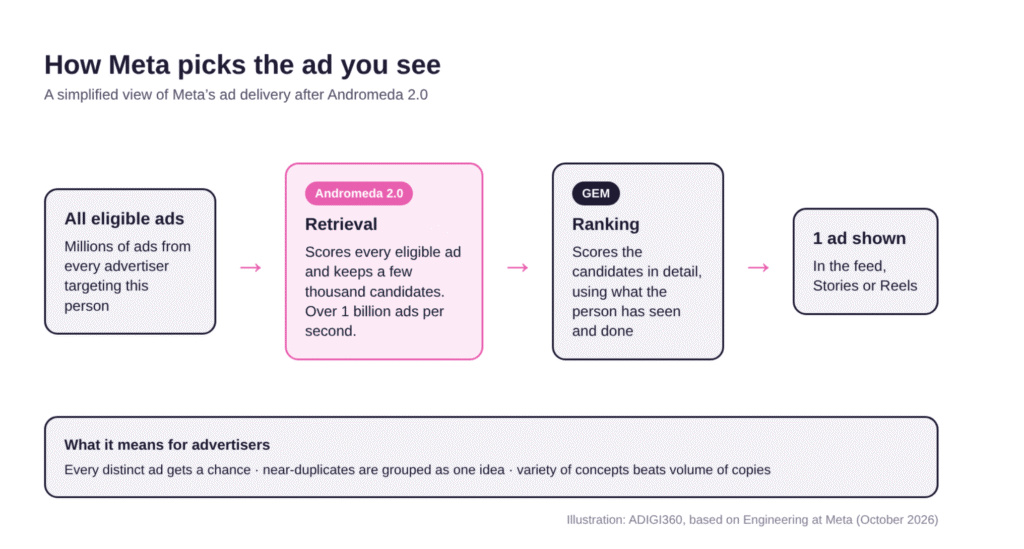
Meta’s ad system works in stages. First, a retrieval system (Andromeda) narrows millions of eligible ads down to a few thousand candidates for each person, in milliseconds. Then a ranking model (Meta calls it GEM) scores those candidates in detail and decides which ad is shown. Meta also uses sequence learning: it looks at what someone has already seen and done to decide what they should see next.
Until now, Meta’s hardware limited how many ads it could fully consider. In practice, the system focused on the ads that were already performing, the “popular shelves”, and many other ads were barely tested.
What is new in 2.0
According to Meta, the new Andromeda scores every eligible ad and surfaces the top candidates at over one billion ads per second, about 100 times the throughput of the 2024 system. Meta has also introduced a new recommendation model that reads the content of each ad: the image, the text on screen, what is said in a video and its music.
Two consequences matter for advertisers:
- Every distinct ad gets a fair chance. A new concept is no longer buried behind your current best performer.
- Near-duplicates are grouped together. If ten ads say the same thing with a different colour or a new headline, Meta treats them as one idea and shows the best one. Volume without variety does not help.
What Montreal brands should do now
- Keep the structure simple. One campaign per offer, broad targeting, automatic placements. You do not need to rebuild your account.
- Build creative around real differences. Change the desire you speak to, the persona (busy parent, student, small business owner), the awareness level (from “I didn’t know this was a problem” to “I’m ready to buy”) and the angle.
- Say it and show it. Meta can only use what is visible in the image or said in the video. If your ideal customer would not recognise themselves in the ad, the algorithm will not either.
- Give ads time. Judge new concepts after about seven days and a reasonable spend, not after 48 hours. Many ads that start slowly catch up.
- Think bilingual. In Montreal, French and English ads are two different concepts for Meta. Writing natively in each language, instead of translating word for word, gives the system more distinct ideas to test.
A simple creative matrix
Take a Montreal coffee roaster selling online. Instead of ten versions of the same “20% off” ad, it can build distinct concepts: a barista explaining how to choose beans for a moka pot (problem aware), a customer review from a busy parent who finally enjoys coffee at home (product aware), a short video of the roasting process in Mile-Ex (brand story), a French ad for long-time fans with a limited holiday blend (most aware).
Each concept changes who it speaks to and why they should care. For Meta’s new system, these are four different ideas that can each find their own audience, instead of ten copies competing for the same people.
How to read your results
Look at results at the campaign level first, not ad by ad. Keep ads that beat your target cost per purchase after a fair test, pause the ones far above it, and give the ones in between more time.
Then use what you learn to brief the next round of concepts. Creative testing becomes a monthly routine rather than a one-time project.
Do not forget the basics
Andromeda itself is only one part of the system. Meta reports that it added about 2.4% more conversions on Facebook since 2025: helpful, but not a miracle. The offer, a simple account structure, strong creative and clean conversion tracking still decide most of the results.
For brands that want help adapting, a Meta ads agency in Montreal like ADIGI360, which manages Meta and Google campaigns for local and Canadian brands, can review the account and build a creative testing plan around these changes.
contributed post