
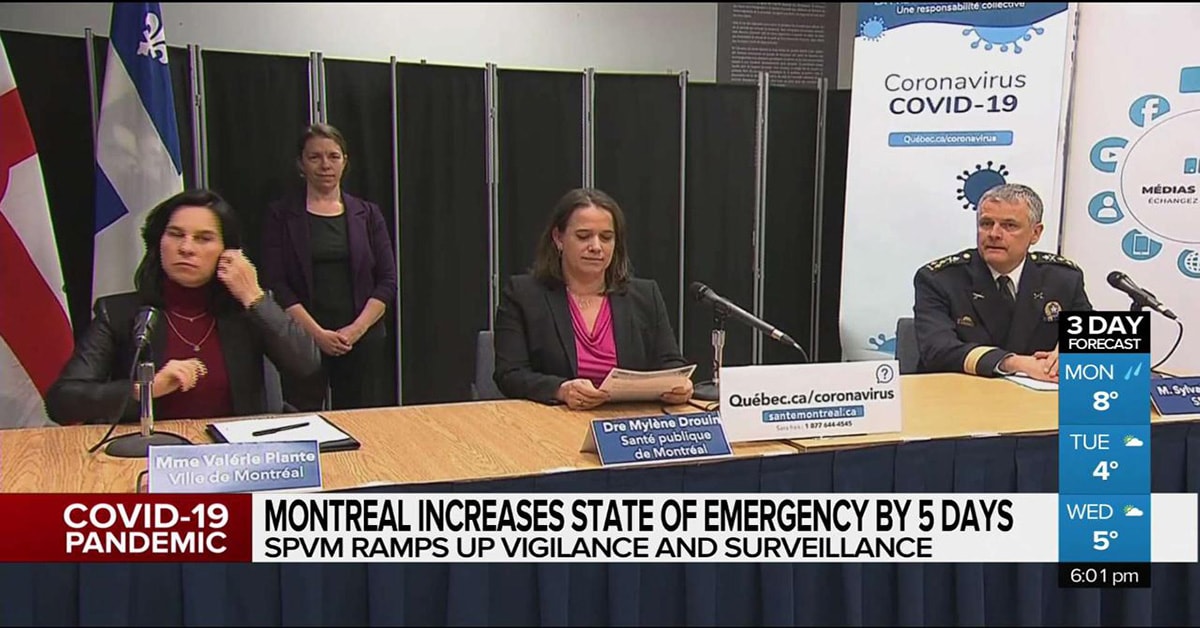
Montreal during COVID-19 – “This is not just a public health crisis, it is a crisis that will touch every sector,” said on March 11 Dr. Tedros Adhanom Ghebreyesus, WHO director-general. He was then officially declaring COVID-19, a pandemic. On March 16 the federal government in Canada and the different provinces started to implement policies to counter the effects of the disease, including the one having the most impact: staying at home. Since then, only essential areas of society have been active: schools, universities, restaurants, bars, cinemas, concert halls, sports venues, and most stores have been closed, and people in most companies and government agencies are working from home. A two-meter separation between people is now the norm in public places and “social distance” (some prefer to call it “physical distance”) has replaced face-to-face interactions.
Of course, most people may feel uncomfortable with these measures, but in the end, we all know that they are in place for the sake of a better good: the protection of our health. So, while there are some complainers, most people are adapting to this new kind of normality. A different story is south of the border, where some people—(idiots?)—are even staging protests for their right to go back to work and be infected (!).
While there is no question that one may miss aspects of the normality we enjoyed before the ubiquitous virus, its irruption may also prompt some critical reflections, some concerning social issues; others, personal choices or behaviours.
Even the so-called normality that many seem to miss might require a thorough and critical analysis. The British think tank ODI (Overseas Development Institute) in its website quotes a phrase written on a wall in Santiago, Chile, where before the COVID-19 outbreak a social upheaval was taking place: “we won’t get back to normal because normal was the problem.”

If we take a detailed look at that idea of “normal,” we may find answers to some of the questions posed by COVID-19, particularly in our province. Quebec leads in the number of cases and deaths in Canada, most of them occurring in long-term residences for seniors. Well, guess what: for decades the Quebec government—regardless of what party was in control: pequistes, Liberals or the CAQ now—was imposing cuts to healthcare resulting in staff reductions in hospitals and lack of enough workers at long-term facilities. Nurses, in particular, have been overburden with work, and so are orderlies who take care of old people in residences. All of that while finance ministers were acting like scrooges when it came to those workers’ salaries. The “normality” of keeping balanced budgets, an ideological mantra repeated ad-nauseam by some politicians and their economic advisers, has now been thrown into the garbage. Quebec is expected to hit a record 12-billion deficit as a result of this crisis, the federal deficit is expected to be much larger. Indeed a well-deserved fate for a neoliberal notion that has proved so disastrous for the healthcare system in Quebec (and in most other provinces too).
For now, then, we are becoming used to stay home, with occasional visits to the local park, the pharmacy, or the grocery store. Justin Trudeau and François Legault’s daily news updates are part of our new routine. Dailies like The Gazette are getting thinner and thinner, and its reliance on Washington Post pieces instead of using local talents make it look more and more as just an American franchise. For its part, the CBC has restored its late-night local newscast, which is something good, even if one has to see Nancy Wood struggling to read the teleprompter. She refuses to wear glasses and seems to resist any thought of retirement.

On the negative side, another casualty of COVID-19 on the cultural front: ComicCon postponed this year’s edition, originally scheduled for July 3-5, to next year, July 9-11. “For pop culture fans, Montreal ComicCon is a not-to-be-missed summer event. We did not relish coming to this, but it is the right thing to do because the safety of our attendees, exhibitors, partners and staff is paramount,” said Alex La Prova, the event’s co-founder.
Five weeks and certainly still more to come, but life will continue: if we are prudent and keep thinking that human lives are more important than any other consideration.

Other articles from totimes.ca and mtltimes.ca

Ordering online groceries becoming unmanageable