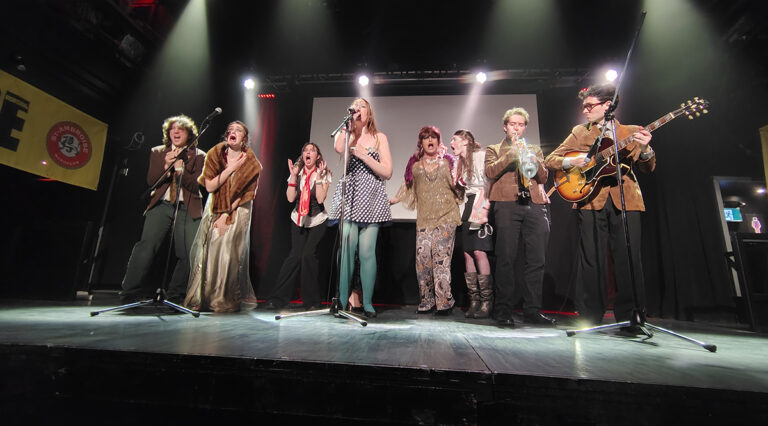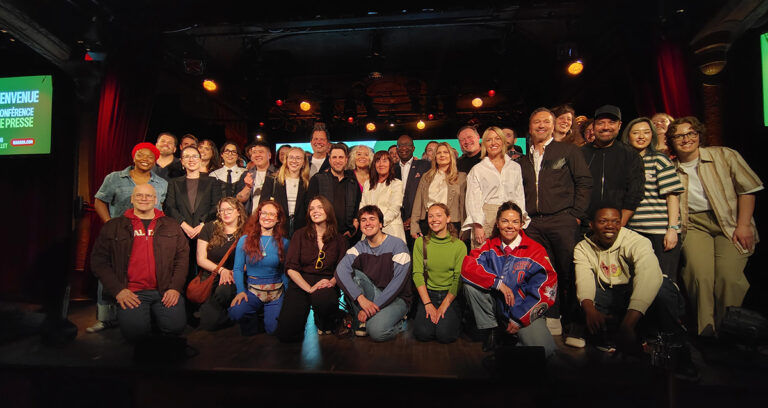
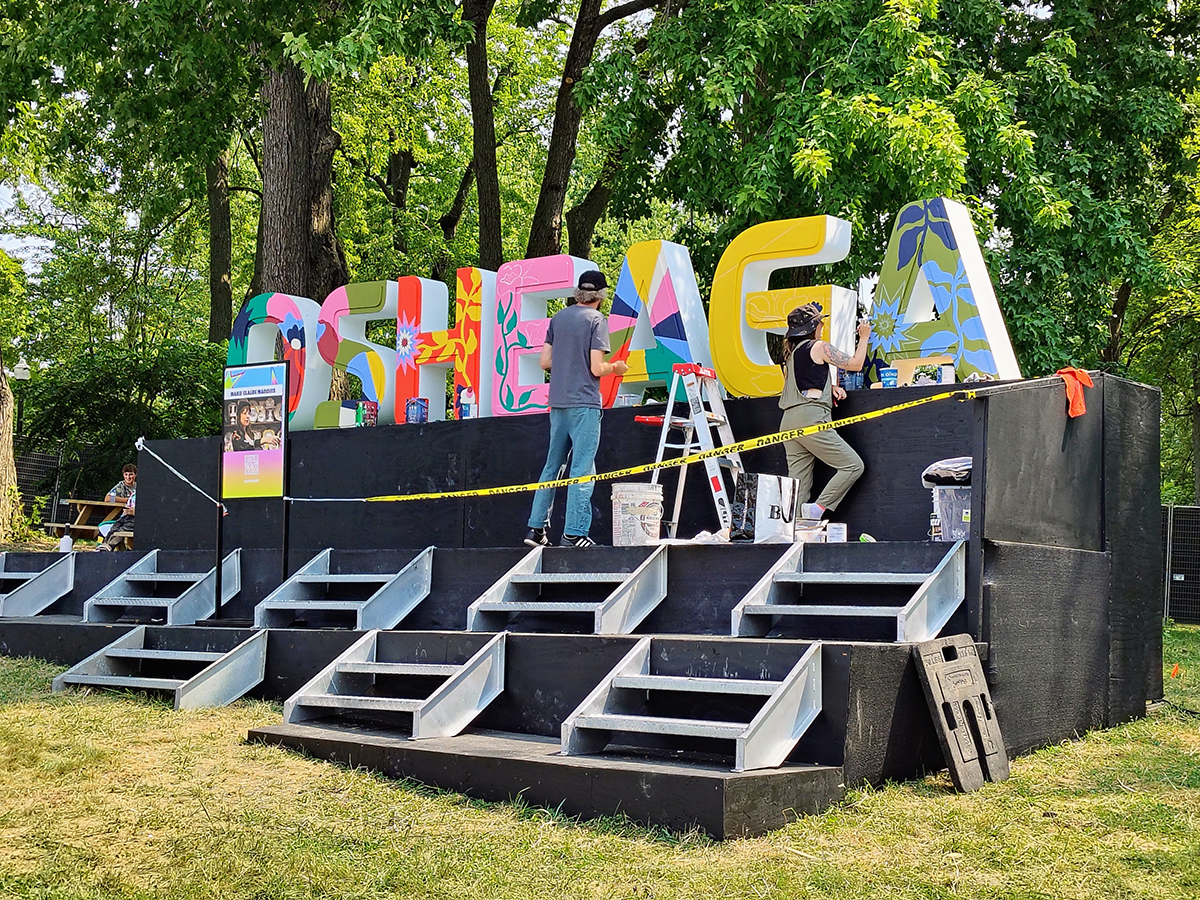
It happens in Montreal every first weekend in August, as Parc Jean Drapeau transforms into a Woodstock-style music and arts festival featuring some of the most popular and up-and-coming singers and bands in the indie music world. This is Osheaga, which takes place this year from July 31 to August 2.
The festival had its genesis in 2006. It was the idea of Nick Farkas, who at the time was a concert buyer for the Gillett Entertainment Group. He realized that there was a lack of venues that showcased indie music on Canada’s East Coast and decided to remedy it. In an interview during its inaugural year, Farkas hoped to turn Osheaga into a major destination event. “That’s the goal, to get people talking about it, and coming from all over,” he said.
On Labour Day weekend of 2006, the inaugural edition of Osheaga (the name is a francization of the Iroquois word “osekare”, which means “beaver dam” or “beaver path”) took place over two days; the headliners that year were Sonic Youth and Ben Harper & the Innocent Criminals.
In 2008, Osheaga switched from Labour Day weekend to the first weekend in August. Since then, indie music fans have flocked to Osheaga in great numbers, and it has averaged a total of 140,000 people during that three-day period. As well, its three-day and single-day tickets have always sold out without fail. Over the past 20 years, the Osheaga festival has had its share of honours and recognition; for example, Pollster ranked it as the #1 festival in Canada, as well as the #11 festival in the world.
The festival has continuously presented on its six stages musical acts that represented a number of musical genres, including blues, country, electronic dance music, folk, hip-hop, jazz, Latin, pop, R&B and rock. Since 2006, more than 600 performers have graced Osheaga’s stages.
Its roster of past performers included some the biggest names in the indie and contemporary music scene, such as the Smashing Pumpkins, the Sam Roberts Band, Coldplay, the Beastie Boys, Arcade Fire, Eminem, Snoop Dogg, Mumford & Sons, the Red Hot Chili Peppers, Billie Eilish, Green Day and Olivia Rodrigo. Headliners for the 2026 edition are Twenty One Pilots, Canadian singer Tate McRae and Lorde, who is returning to Osheaga after a nine-year absence.
Besides the headlining acts who are scheduled to perform at Osheaga, it also boasts 14 local artists and bands as part of its line-up.
One of those local bands is Museums, a Montreal quartet who will be performing at the Backyards Sessions Sirius XM stage on August 1 at 4 p.m.
“This is our first time performing at Osheaga. I grew up going to the festival, and it was our goal and our dream to eventually perform there. And because this is happening so early in our career, we find it quite astonishing,” said Ali Kouri, the group’s lead guitarist and vocalist, during a recent phone interview.
The group, which also includes Nic Barkun, Anthony Kameka and Lou Raskin, formed Museums back in 2024, and they brought a great deal of experience to the group. “Everyone had their respective musical backgrounds playing for other groups — like the folk rock group The Daydreamers — and when we came together, it was an organic experience and we had a nice chemistry from the beginning,” said Ms. Kouri.
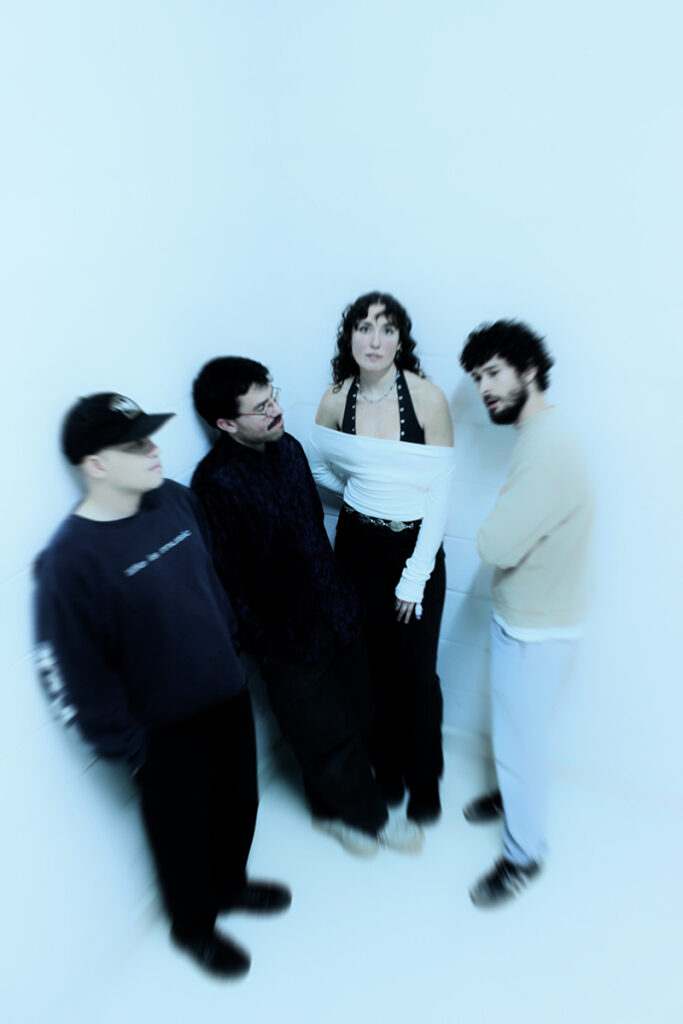
Museums’ music style is defined as psychedelic art rock, but Ms. Kouri is adamant that they shouldn’t be pigeonholed into that particular category. “Our musical influences are vast, but people shouldn’t put us in a box. That psychedelic art rock genre is more like an umbrella term for us; there are also traces of indie rock and pop music in our songs. We invite the festival goers to come and see us play and let them tell us what they think,” she said.
The timing couldn’t be more right for Museums to make their Osheaga debut, as their six-song EP “This Can’t Be It” was recently released by Petit Village Records. The songs from the EP have already made its way to Spotify lists in Quebec and around the world. Their post-Osheaga road will include some time off, participating in RBC’s First Step mentorship/entrepreneurship program, and a return to the recording studio to work on their first LP album, which they hope to release in 2027.
The other local artists who are part of this year’s Osheaga line-up include Virginie B, Billie du Page, Grand Eugene, Moonshine, Fernie, Berlam, Wolf Parade, Super Plage, Oliver Forest, Lou Val, Moses Belanger, Delavelour and Laura Scavo.
In the weeks leading to the Osheaga festival, you can’t miss the customary signs and billboards across Montreal that colorfully list the artists who are scheduled to perform during those three days in early August.
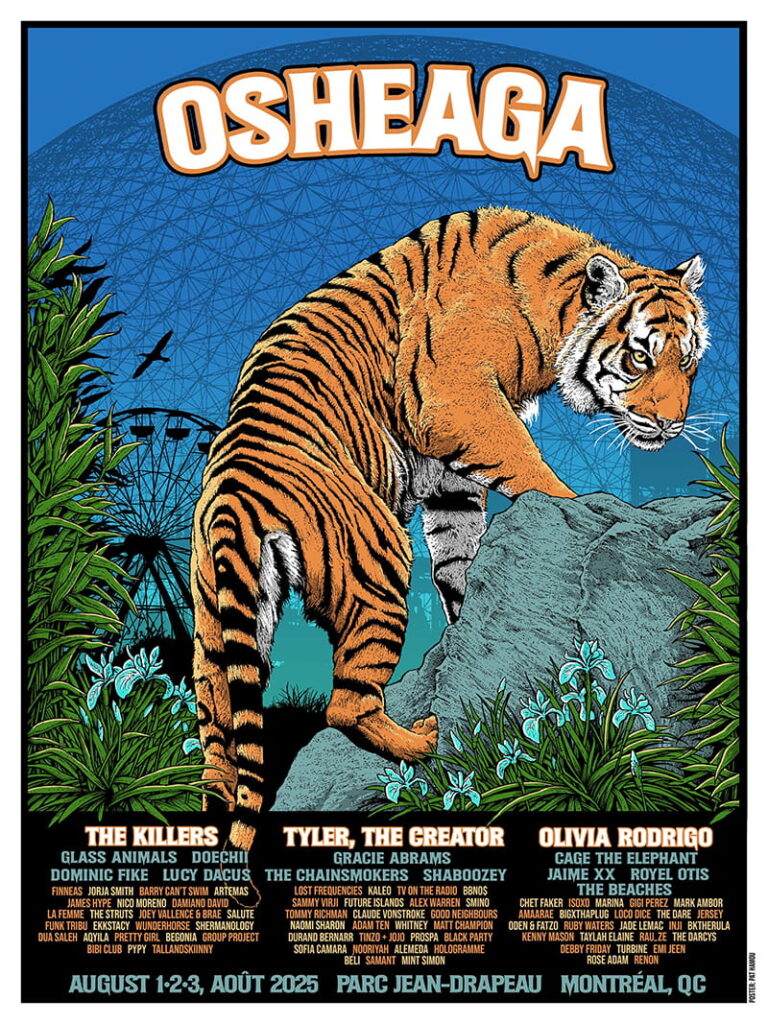
At the festival site at Parc Jean Drapeau, one of the popular festival merchandise items is the official poster that also lists that year’s line-up, but in a more colorful, illustrated, eye-catching design.
The above-mentioned Osheaga items are the work of one person: Montreal illustrator Pat Hamou.
Exclusive Interview with Osheaga Poster Artist – Pat Hamou
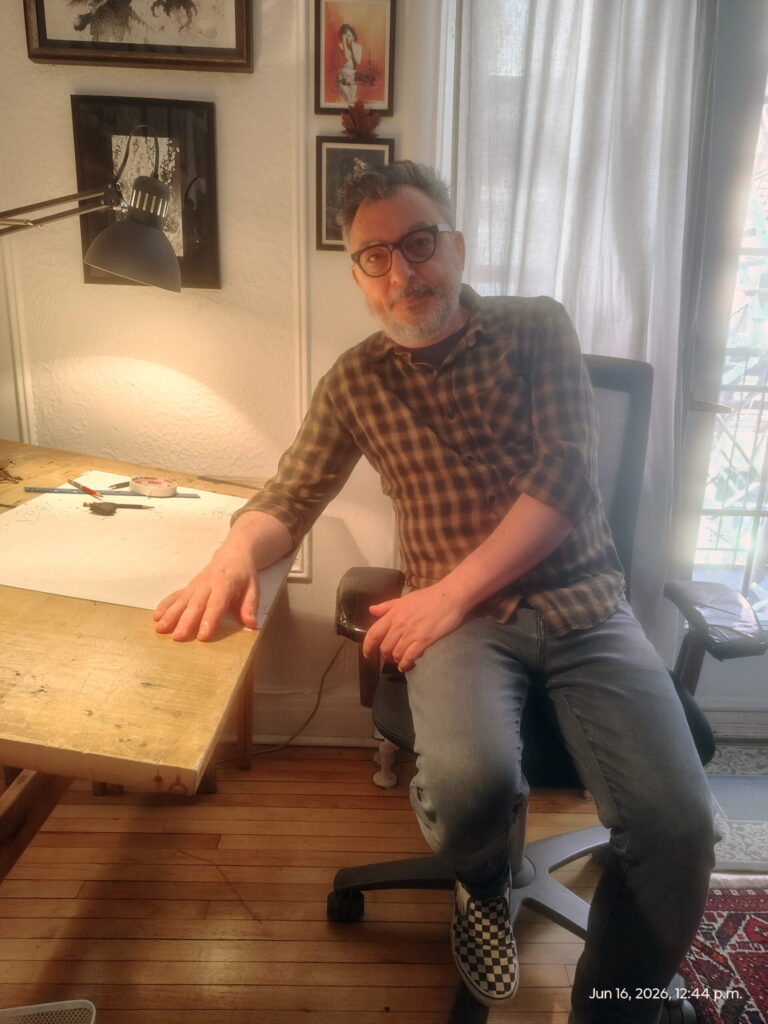
Born in Paris, France, Pat and his family moved to Montreal when he was five years old, and then settled in Ville St. Laurent three years later. It was during his formative years there that Pat began drawing. He was a big fan of the cartoon series The Flintstones as well as comic books, and continually drew comics and also caricatures based on the news events of the day. A defining moment came when he won a bicycle safety poster contest at his elementary school.
“When I won that contest, I thought rather whimsically that I can make a living out of this, and that it was something that I wanted to do,” he said during a recent interview at his home studio in Outremont.
When he was a student at Sir Winston Churchill High School, Pat amused his classmates (myself included) with his many accurate caricatures of our teachers; he also contributed drawings that graced the pages of the school’s yearbook for our graduating year of 1980.
From there, he studied fine arts and commercial art design at Dawson College. During that time, he worked at Nova, a popular science fiction and comic book store that was located in downtown Montreal, during the 80s. When he graduated from Dawson, he somehow wasn’t sure of the direction he wanted to take. “I felt disillusioned after Dawson. I went to a few commercial art agencies, but it wasn’t my thing,” he said.
At the same time, he began to meet a lot of musicians and had roommates who performed with local bands, which became his entrance to the music business. “After a stint working at CKUT Radio McGill, they began to ask me to do graphics for them, like t-shirts and posters. From there, I got a job with Cargo Records, a major Montreal in-house label and distributor, where I created album covers and advertisements, such as street posters. After Cargo, I worked as a researcher at the CBC,” he said.
He was offered a job to do in-house designs for Greenland Productions, a start up concert promotion and production company that was founded in the early 90s by Nick Farkas. From 2001-2007, Pat worked as an in-house graphic designer for another Montreal record label called Ninja Tune. During Pat’s time at Ninja, Nick worked at the major Montreal concert and entertainment promotion company evenko, where he was its Senior Vice President of booking and concerts. He was also in the midst of creating a new Woodstock-style music and arts festival that catered to fans of contemporary music called Osheaga.
“Nick and me became good friends when I worked at Greenland. After Nick joined evenko, he asked me to curate an exhibition called ‘Music on Paper’, which I would select posters that were specially created for singers and bands to be displayed,” he said. “The exhibition was originally situated in a gallery space, and then moved to the festival site in 2012, where it was housed in a small tent.” The exhibition stopped after the COVID pandemic, but the Music on Paper tent remains an integral part of the Osheaga festival, in which Pat still curates posters of the artists who perform at that year’s festival, which are on display and available for purchase, along with Pat’s current and past versions of the official festival poster.
Pat has done some of the key art for Osheaga and Lasso Montreal, which include their respective line-ups in their entirety, as well as the screen print posters that are sold during the course of the festival. The process from concept to reality takes about three to four weeks prior to Osheaga to formulate a design that would be eye-catching to the festival goers.
“It’s a bit of a struggle to come up with something. I start to think about it for months ahead to see what would work,” he said. “Some of the elements that I usually include are the Biosphere, because it’s an iconic landmark at the festival. I also try to incorporate nature elements and even animals that correspond to the Chinese new year calendar,” (i.e., the 2025 poster included an imposing image of a tiger to mark the Year of the Tiger).
“The poster has to include imagery that people would like. It has to be fresh every year and marry images to a feeling. It has to stand out in its own way,” he added.
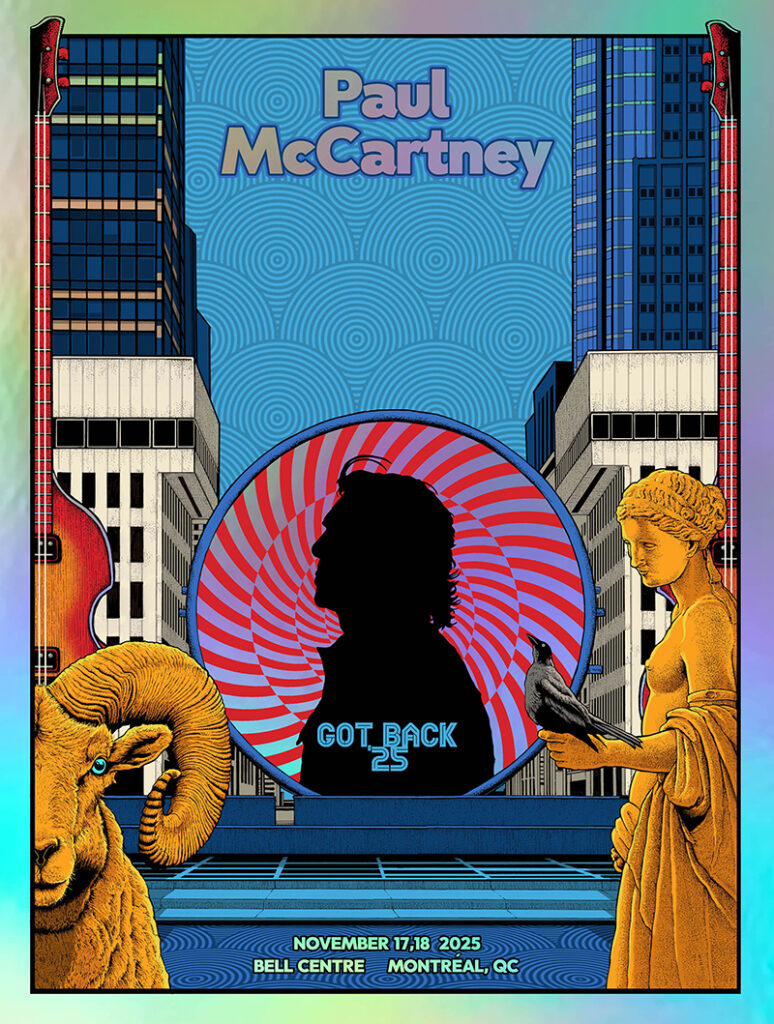
Besides Osheaga, Pat also designs posters and graphics for a number of bands and artists such as Jack White, Queens of the Stone Age and The Tragically Hip. Last year, he had the good fortune of being selected to design a concert poster for Paul McCartney’s successful Got Back North American Tour, in which posters were created to represent each city that was on the tour’s itinerary.
“I previously worked with McCartney’s company that handled his merchandise and one thing led to another,” he said. “They reached out to me and originally asked me to design the poster for the St. Louis leg of the tour; that happened a week before the tour dates were announced. I asked them if I could do the Montreal poster instead, because I had a closer connection to the city, and I could easily incorporate local imagery. I was lucky that they liked my work in the end, and I was happy they asked me to do it.”
Pat has worked as a freelance illustrator for the past 15 years, and has witnessed the changing trends in the music business, especially when it comes to merchandising. “Bands who create their own posters as merchandise has picked up dramatically since 2010, and that’s because there has been less money to be made on record sales, so they had to generate more income when they are on the road,” he said. “It also means the market has opened up for illustrators, and it’s still expanding; however, it’s now become more competitive. For example, there are now 35 bands who compete for the services of 34 illustrators.”
“Drawing feels natural to me. I am lucky to achieve the kind of freedom where I can pursue the thing that I can do.”
For more information, or to purchase some of Pat Hamou’s past poster art, go to pathamou.net.