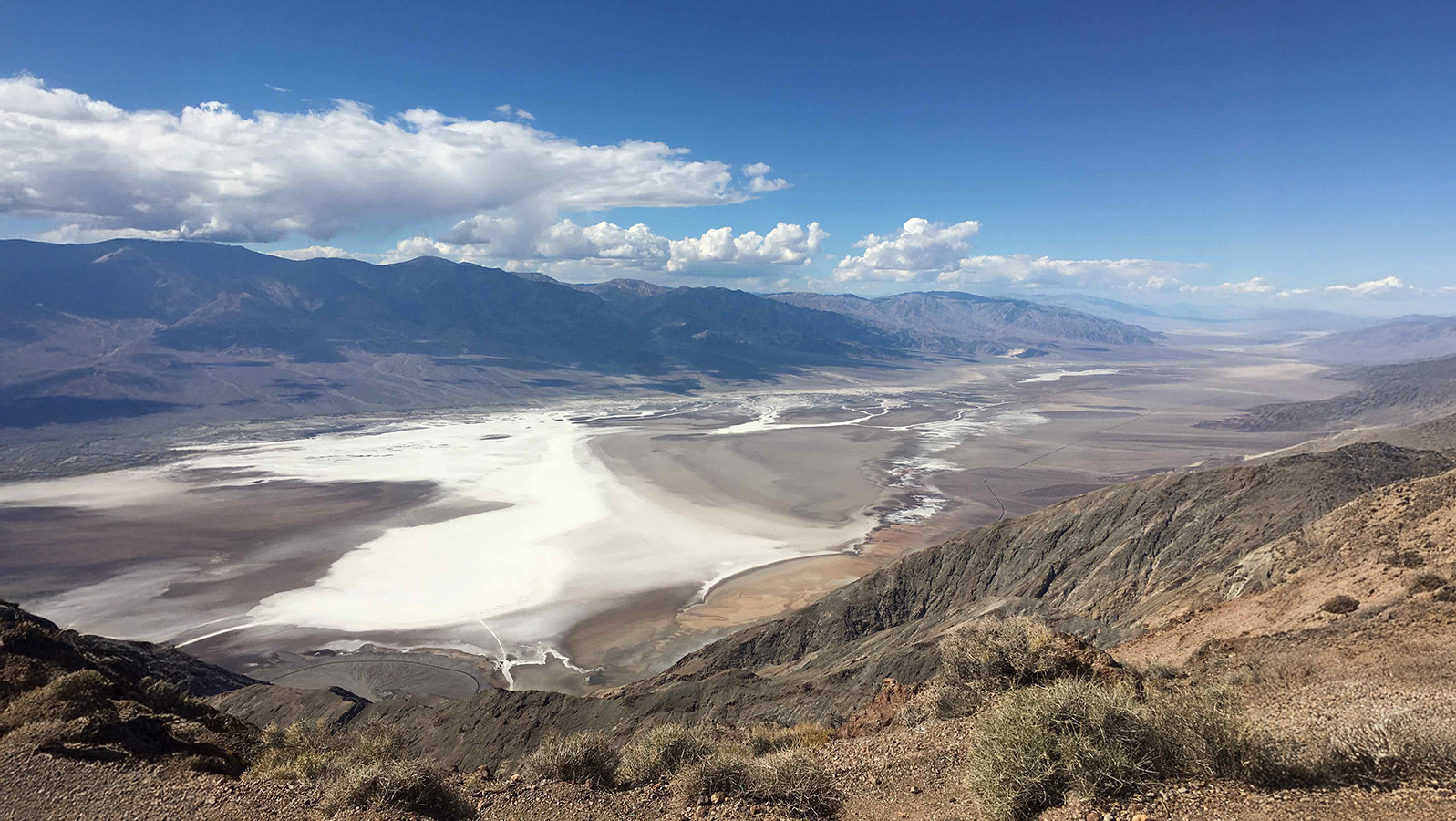
For many Quebecers, Las Vegas is synonymous with neon lights, shows, and casinos. Yet, just over 190 kilometers from the Strip, one of the most spectacular landscapes in the American West awaits curious travelers: Death Valley. This national park, straddling California and Nevada, is the hottest and lowest-lying national park in the United States. Here’s how to visit Death Valley from Las Vegas and fully enjoy it in a single day.
Where does this ominous name come from?
The name dates back to the winter of 1849. A group of pioneers heading to the California gold mines thought they would save time by cutting through the valley. They found themselves trapped there for several weeks, running out of water and food. As they were about to leave, one of them is said to have turned around and called out, “Goodbye, Death Valley!” The name stuck, even though the valley is actually home to a surprisingly rich array of flora and fauna, adapted to its extreme conditions.
When to leave?
The best time to visit is from October to April. Temperatures are pleasant then, often between 20 and 30°C during the day, and the winter light beautifully highlights the landscape. This is also when many Quebecers escape the cold for a few days of sunshine in Nevada.
In summer, however, the heat becomes extreme. It was at Furnace Creek in 1913 that the record temperature of 56.7°C was recorded, the highest ever officially recorded on Earth. A visit is still possible in July or August, provided you leave very early, shorten the hikes, and stay close to an air-conditioned vehicle.
Good to know: Las Vegas is on Pacific Time, which is three hours behind Montreal or Quebec City. This time difference works in your favor: getting up at 6 a.m. to head out into the desert seems much less daunting for the first few days.
The park’s must-sees
Zabriskie Point
It’s often the first stop when arriving from Las Vegas. From the lookout, you overlook a sea of eroded hills in shades of gold and brown, ancient lake sediments carved by millions of years of erosion. The place is magnificent at sunrise, but it’s impressive at any time of day. It owes its name to Christian Zabriskie, vice president and general manager of the Pacific Coast Borax Company in the early 20th century, when borax was mined in the valley.
Badwater Basin
Badwater Basin is a dried-up salt lake located nearly 86 meters below sea level: it’s the lowest point in North America. You walk on a brilliant white salt crust, patterned in polygons, with the Panamint Mountains as a backdrop. Look up at the cliff: a small sign indicates the sea level, high above you. Legend has it that the site is named after a surveyor whose mule refused to drink the overly salty water of the nearby small basin.
Artist’s Palette
On this mountainside, the minerals in the rock have colored the landscape pink, green, purple, and ochre. The one-way road leading there winds its way between the hills. It’s one of the most photogenic spots in the park, especially in the late afternoon.
Furnace Creek and the Mesquite Dunes
Furnace Creek is the true oasis of the valley. Here you’ll find the visitor center, a few palm trees, and a small museum that tells the story of borax and the region’s first inhabitants. Further on, the Mesquite dunes give the park a Saharan feel. The golden sand takes on beautiful hues at the end of the day. In the 1880s, teams of twenty mules transported the borax extracted from the valley across the desert: these convoys have become one of the valley’s symbols.
Rhyolite, the ghost town
Leaving the park on the Nevada side, Rhyolite is worth a stop. Founded in 1904 during the Gold Rush, the town reached its peak in 1908, then was deserted within a few years. Today, only the facades of a bank, a train station, and a striking house made of bottles remain.
Should I go alone or with a guide?
Renting a car in Las Vegas is easy, and the roads are good. However, it takes about two hours to reach the park, and then there are long distances between stops. Gas stations are scarce and expensive, and cell service is virtually nonexistent in much of the valley.
For a first visit, many travelers prefer a guided tour. You can enjoy the scenery without driving after a long evening on the Strip, and you gain a better understanding of what you’re seeing: geology, mining history, and wildlife adapted to the heat. For French speakers, it’s also an opportunity to ask all their questions in their own language.
This is the package offered by Las Vegas Aventures, a local, French-speaking agency based in Las Vegas. To visit Death Valley in French , their guides pick you up at your hotel around 6:30 a.m. and drop you off around 5:00 or 6:00 p.m. The day follows the order of stops described above, including a picnic at Furnace Creek, in a small group of no more than six people.
Our practical advice
- Bring plenty of water , even in winter: the air is extremely dry and you can become dehydrated without realizing it.
- Protect yourself from the sun : a hat, sunglasses and sunscreen are essential all year round.
- Pack layers of clothing : in winter, mornings can be cool while afternoons are warm.
- Wear appropriate footwear : the salt crust of Badwater and the sand of the dunes require good closed shoes.
- Fill up your tank before you leave if you are driving yourself, and download an offline map.
- Have a quiet evening : the day is long, and we often come home tired but happy.
In Summary
Death Valley is the perfect day trip to escape the hustle and bustle of Las Vegas and discover another side of the American West. Choose the right season, leave early, and let yourself be amazed by these landscapes that seem to come from another planet. Whether you go independently or with Las Vegas Adventures, you’ll return to Quebec with unforgettable memories.
contributed post