On the night of March 2-3, we will be able to see a total lunar eclipse visible from Quebec. Here is a brief description of the phenomenon of lunar eclipses, taken from my book, Les yeux tournés vers le ciel.
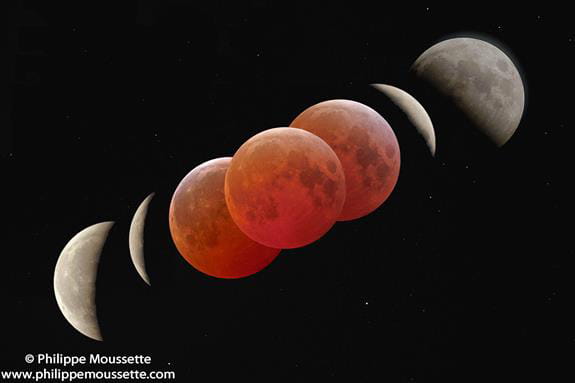
On the night of March 2-3, we will have the opportunity to see a total lunar eclipse in Quebec, with all its phases. The partial eclipse will begin around 4:50 a.m. and end at 6:17 a.m. at moonset. Note that the eclipse is easily visible from your home with the naked eye or with a small pair of binoculars. If you would like more information about the eclipse, please feel free to contact me.
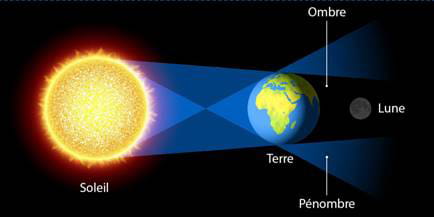
A lunar eclipse occurs when the Moon passes through the Earth’s shadow, and sunlight no longer reaches it directly. The Moon then appears red. This phenomenon occurs several times a year. There are three types of eclipses: countable eclipses, when the Moon only passes through the Earth’s penumbra; partial eclipses, when the Moon only partially passes through the Earth’s shadow; and total eclipses, when the Moon completely passes through the Earth’s shadow. These are undoubtedly the most spectacular eclipses.
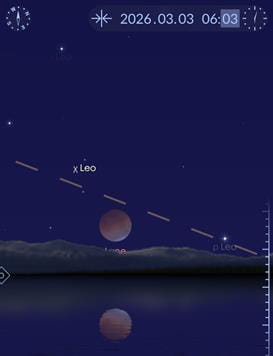
Timing of the Lunar Eclipse in Quebec
Partial eclipse begins: 4:50 AM
Total eclipse begins: 6:04 AM
Moonset: 6:17 AM
Mid-eclipse: 6:33 AM (Not visible from Quebec City)
Total eclipse ends: 7:02 AM (Not visible from Quebec City)
Partial eclipse ends: 8:17 AM (Not visible from Quebec City)
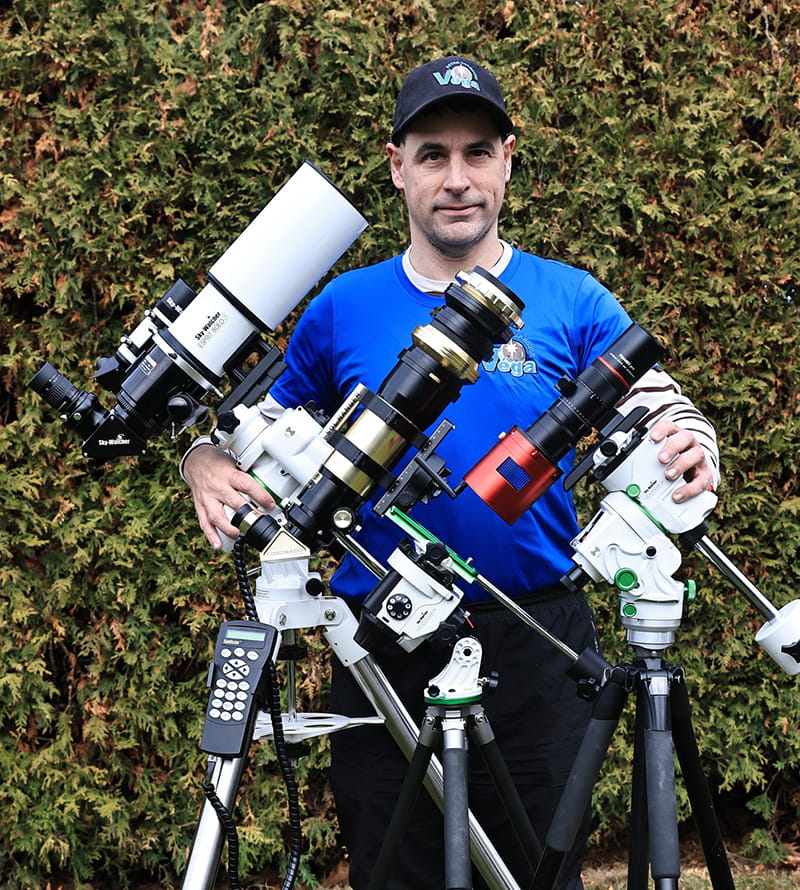
Amateur astronomer Philippe Moussette, known for his versatility, has re-released his book on astronomy and his unconventional career path, “Eyes Turned to the Sky!”
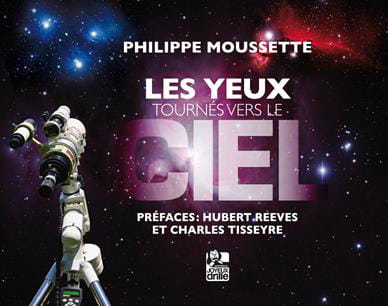
Les yeux tournés vers le ciel (Eyes Turned to the Sky)
by Philippe Mousette
More than 200 photos and tips of the trade are featured on glossy paper in this magnificent book, “Eyes Turned to the Sky.” The result of several years of hard work, this unique book presents over 200 celestial objects (planets, constellations, comets, stars, nebulae, clusters, supernovas) in the form of photographs taken by the author.
Some of these serve as the basis for a sky chart that facilitates the identification of these objects. A few required several nights of waiting and retaking, but for this action-oriented astronomer, well-known in the educational and media circles of the Quebec City region, nothing is impossible: it’s all about patience and perseverance. The first edition was published in 2011, and this one has been completely revamped with the addition of numerous photos and information. Note that 98% of the photos illustrating the book are by the author.
submitted by Philippe Mousette
Other articles from totimes.ca – otttimes.ca – mtltimes.ca