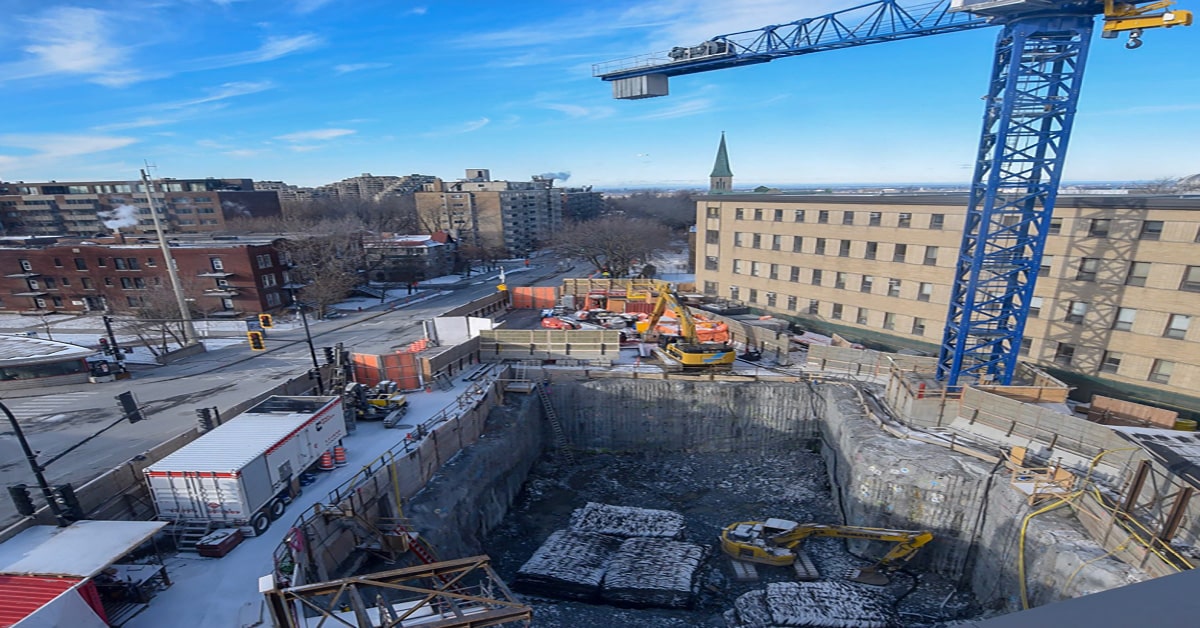
It is a massive undertaking. In order to build the REM’s Edouard-Montpetit station, workers first have to dig down to the metro’s blue line and then to the tunnel under Mount-Royal – the equivalent of at least 20 storeys. They refer to it as a ‘surgical operation, as they have to dig through a very hard, densely built sector of bedrock. And it is no easy task.

Because of the challenges involved, they chose a method of ‘controlled blasting’. It is technique involving the use of small explosives to slowly break up the layers of bedrock. Cranes then collect all the rock cuttings and put them into load bearing trucks to be taken away. They hired some of the best experts in the field to define the drilling and blasting parameters and methods, including Pierre Groleau, a mining engineer and explosives expert for NouvLR. He has worked on projects in many countries, as well as on urban construction sites and ‘large-scale mega surface, underground and underwater’ projects. According to Groleau, ‘the challenge and complexity of the Edouard-Montpetit site is based on its proximity to homes, schools and utilities’ and ‘the type of activity must take these important considerations into account to manage vibrations and rock projections during controlled blasting’.

Special measures are always used to ensure the safety of not only the workers, but also the public and surrounding infrastructure – and planning everything is taken very seriously. They do a ‘soil characterization’ (to determine the nature and extent of any contamination in the soil) and use line drilling and ‘compartmentalized blasting’ in order to reduce the vibrations felt during the work. Each blast is monitored by seismographs placed around the site and they cover the area with layers of ‘blasting mats’ with a ‘dual layer of geotextile membrane’ in order to control any flying rocks or stones.

Taking it even a step further, they are only using the best products available. High-precision electronic detonators are used, enabling them to check the ignition sequence of a blast in order to identify, locate and correct any mistakes before proceeding. Once completed, the station will be the second-deepest in North America at 70 meters, with the Washington Park light rail station located in Portland, Oregon being the deepest at 79 metres. The whole operation to excavate the main shaft at Edouard-Montpetit began in October of 2018 and they are soon ready for the next step – to build the underground REM station, scheduled to open in 2022. And as they say, what you see of the site at surface level is ‘only the tip of a highly complex iceberg’.
Once in operation, travel times from the station to different parts of the REM’s four lines will be as follows: McGill (green line) 3 minutes, Bonaventure-Gare Centrale (orange line) 4 minutes, Station A40 (Mascouche line) 6 minutes, Montreal-Trudeau Airport 16 minutes, Dix-30 Brossard 17 minutes, Kirkland, 26 minutes and Deux-Montagnes 29 minutes. You can watch a short video of a blast.

Other articles: